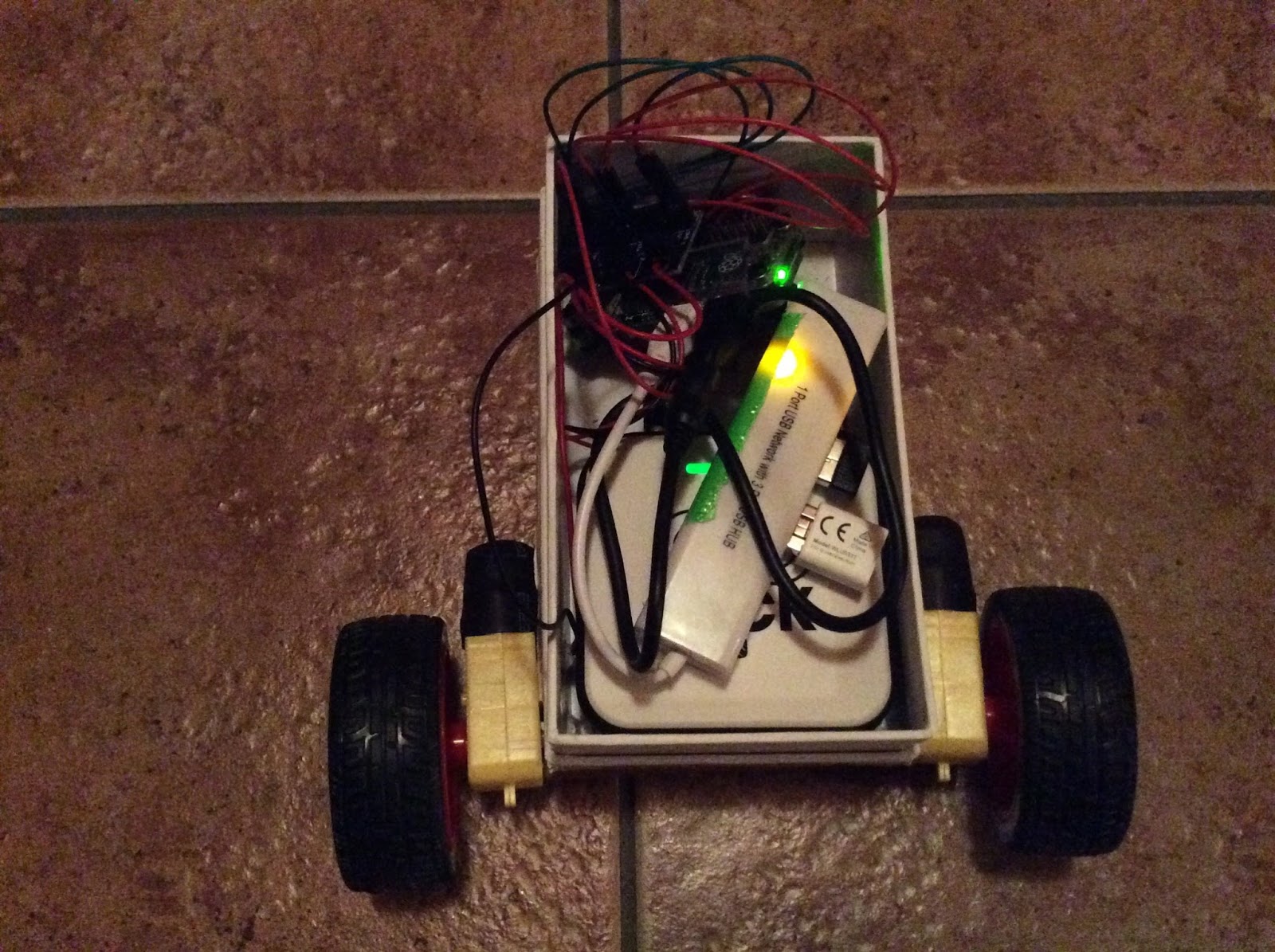
I recently started learning about Raspberry Pi. One thing I'm really excited about is the CamJam EduKit #3 Robotics kit, available through the Pi Hut. In the process of experimenting with this kit, I've started learning basic programming in Python, and I'm starting to understand how the GPIO pins work. In addition to coming with two motors and some wheels, the kit comes with a line sensor and an ultrasonic sensor to help your robot avoid obstacles. Support worksheets for the kit are pretty easy to follow and encourage experimentation.
Pi Zero Robot
In one breakthrough, I learned how to talk to my Pi using another computer via Secure Shell (SSH). Now, my Pi doesn't have to be tethered to a monitor, which is useful for building things that move.
While most of the code written for the CamJam EduKit #3 works the same way with a Pi Zero as as a Pi 3, the ultrasonic sensor appears to be an exception. I don't yet understand why, but I've confirmed this to be the case.
On our last day at the Create Make Learn conference in Burlington, Vermont, several of us were fortunate to have the opportunity to create little robotic jitterbugs. Our jitterbugs were powered with craft motors connected to AA batteries. The circular platform of my robot is made from a CD, its propeller is made from a glue stick, and its base has been constructed from four up-cycled film canisters.
Although constructing the jitterbug was great fun, there was quite a lot of problem solving and experimentation involved in constructing it.
While mounting the battery and motor to the underside made the jitterbug more aesthetically pleasing, I soon figured out that the electrical tape holding the battery to the motor was not strong enough to maintain a strong connection. I also learned through trial error that the my propeller needed to be slightly off-center, without touching the floor, in order for my jitterbug to move around, rather than jumping up and down in one spot.
This project required me to apply the following practices, as outlined by the Next Generation Science Standards.