Monday, September 22, 2014

Encouraging Student Self-Reflection (30 Day Blogging Challenge: Day 19)

Name three powerful  ways students can reflect on their learning, then discuss closely the one you use most often.

There are a variety of ways that students can reflect on their learning, as long as enough time is provided and the expectation for thoughtful reflection is modeled and made explicit.  My favorite ways to encourage reflection are through:
  • discussion (peer conferencing, conversations)
  • writing (statements of intent or observations about what worked and what didn't)
  • self-assessment
The one that I use most often is asking students to self-assess their work.  When I ask a student to self-assess their work, I often ask them to evaluate projects based upon the criteria outlined on a rubric, and then take it a step further.  The meaty, meaningful part comes when students explain what their process was, what they are most proud of, and areas where they had the most difficulty, in order to help themselves determine how they might improve in the future.  Students who curate samples of their own work in the form of a digital portfolio (or some other type of evidence) can learn to be more reflective as they document their own growth.

(This derivative work was created under a Creative Commons license, courtesy of chrisotruro §catching up§ /Flickr/ CC BY NC SA)


Google Educator


I am officially a Google  Educator!


Update:   I completed the new Level 1 and Level 2 certifications!

Thursday, September 18, 2014

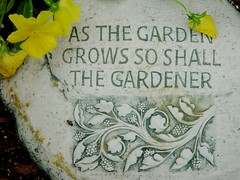
Teachers are Gardeners (30 Day Blogging Challenge: Day 18)

Create a metaphor/simile/analogy that describes your teaching philosophy.  

Gardener by one2c900d, on Flickr
Creative Commons Creative Commons Attribution-No Derivative Works 2.0 Generic License   by  one2c900d 

A good teacher is a constant gardener who plants seeds, celebrates new growth, and looks hopefully to the future for a bountiful harvest.    Like a gardener clearing away the weeds and providing fertile, nourishing soil for tender roots to unfurl, teachers labor to create a stimulating, safe environment where ideas, skills, and people can grow.   Teachers and gardeners know that while it's their job to cultivate and encourage new growth, they ultimately have to trust in the promise of the seed.  

Wednesday, September 17, 2014

A Challenge to Education (30 Day Blogging Challenge: Day 17)

What is the most challenging issue in education today?

This is a monumental question that could easily take hours, days, weeks, and years to reflect upon.  The answer that follows is my initial thought on the subject; it could change as I spend more time pondering the idea.


Schools often have a difficult time keeping pace with a rapidly changing society.  When it comes to change, schools sometimes operate at a snail's pace.  There are many reasons for this including social, economic, and political pressures that make rapid change nearly impossible.  There are also structural obstacles such as traditional schedules and age cohorts that group students together based upon their age rather than other attributes, such as skills or interests.  Sir Ken Robinson speaks elegantly upon this issue, going so far as to accuse schools of "killing creativity," because they are not innovating quickly enough.  

While there are great deal of expectations upon schools to provide students with the skills and habits of learning that they need, to allow them to be competitive in an increasingly globalized world, schools also struggle to keep pace with evolving technology.  It's not due to a lack of effort, however.  Administrators and teachers know what students need, and they are doing their best to design learning opportunities that address this issue.  While progress is being made, schools are increasingly working with limited resources and are being challenged by testing requirements, aging infrastructures, and increasing poverty.  

I've addressed the prompt for the day, and am now left to think about what the solution might be.

Tuesday, September 16, 2014

My Superpower (30 Day Blogging Challenge: Day 16)

What superpower would I want if I could have one, and how might it help me in the classroom?


If I could have a superpower to help me in the classroom, I would want the ability to be in more than one place at a time, while managing to keep track of all of my different activities.  If I could be in multiple places at once, I would have the ability to do all of the things that I want and need to do.

One of my selves could be teaching a class or collaborating with a colleague, while other selves were off lesson planning, attending meetings, or taking classes.  Another self could be taking a walk down a country road with a friend, delighting in the beauty of the natural world, while another was at home cooking a nutritious meal for my family or creating ridiculous pieces of useless art. Yet another self could be taking a nap, traveling to an exotic country, or thoughtfully writing profound blog posts about women who manage to have it all.

If I had the power to multitask in this extraordinary way, I might never feel like I was letting anyone down, and I would always have enough energy to do my best work.


Three Strengths I Have (30 Day Blogging Challenge: Day 15)

Today's prompt is to name three strengths I have as an educator.


Creative Outlet by mark sebastian, on Flickr
Creative Commons Creative Commons Attribution-Share Alike 2.0 Generic License   by  mark sebastian 

I am creative. 

Not only do I love making things and designing curriculum, I thrive on the process of expansive thinking and am content to live with uncertainty.  I find this valuable as an educator, because life is full of unanswerable questions.


I am persistent.

I don't give up on my self, my dreams, or my students. Because of this, I am motivated by hope.


2012-171 Teacher is Chief Learner by mrsdkrebs, on Flickr
Creative Commons Creative Commons Attribution 2.0 Generic License   by  mrsdkrebs 

I am a life-long learner.

Nothing makes my toes tingle more than playing around and learning something new.  My curiosity about the world and desire to learn through exploration helps me to design activities that are engaging for students.

What is Feedback? (30 Day Blogging Challenge: Day 14)

Today's (belated) prompt is, "What is feedback for learning, and how often do you give it to students?"


When I worked as a humanities teacher, formative feedback often took the form of written comments on essays or written/spoken suggestions during peer and teacher conferencing.  Summative feedback more frequently looked like a score on a rubric or test/ quiz.   I routinely allowed students to make revisions to written work and to resubmit assignments, because I believe the process of revision is so important.

More recently, while I was teaching a Computer Apps class at BRMS, feedback took other forms. In addition to using rubrics to assess projects,  I more frequently used quick check-ins and assessments. These not only gave me feedback about my students, but they also provided my students with immediate feedback about areas they needed to spend more time focusing upon.  For example, when introducing students to copyright, Fair Use, and Creative Commons, I administered pre-assessments using either a Google Form that I quickly graded with Flubaroo or quizzes on Socrative. 

I was also fortunate to have a class set-up that allowed me to demonstrate an activity (sometimes via screen cast or a YouTube video) and then give students structured studio time in which to create, while I circulated around the room answering questions as they arose.